
This week kind of felt like the beginning of the end of our trip. I cannot believe this experiment is already more than halfway through. I think it hit a little harder because we left the Philippines after almost three months there. That is a long time to spend in one country, but it gave us the chance to see so many different sides of it and really experience the culture.
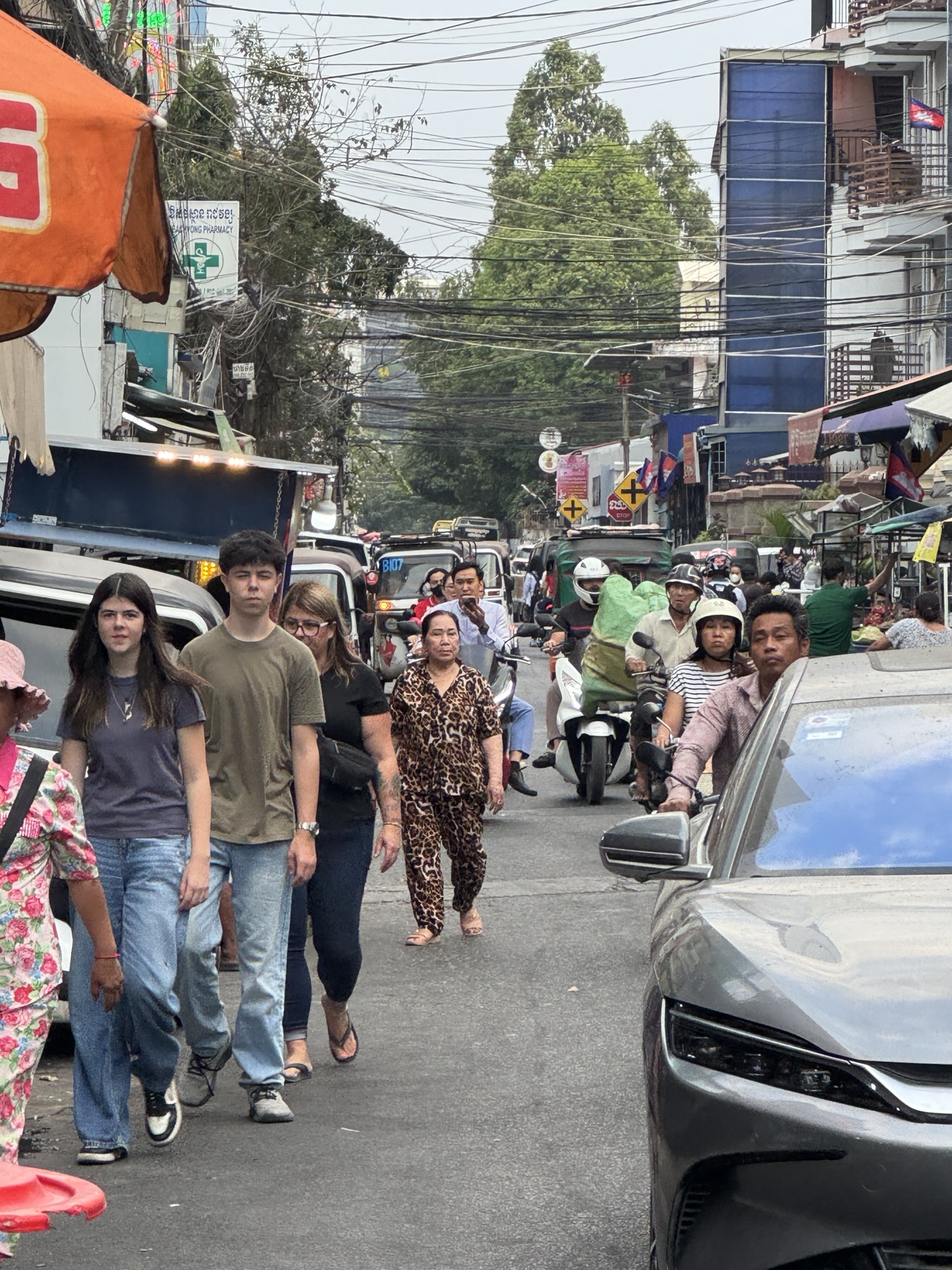
Last Saturday, we hopped on a quick flight from Manila to Cambodia. We planned to spend two weeks here, starting in the capital city of Phnom Penh, (pronounced puh-nom-pen). Phnom Penh is a small big city. It has all the amenities you could want, but it is still quiet and manageable. It ended up being the perfect place to settle in and focus on school, blogs, and job applications.


We spent most of our days at a rooftop bar, working away on our computers, venturing out for local coffee or meat skewers from a street grill, or dropping off laundry with the sweet little couple who washed it and hung it to dry right on the sidewalk. We arrived early on Sunday morning, so after a good night’s sleep and a day of homework, we hopped into a tuktuk and headed to the riverfront for the weekend market.


It was probably the biggest night market we have been to so far. There were endless options for food, souvenirs, shoes, and bags. Lots of bags, just not the bag. Yet. Ethan picked up a crab for dinner, Ainsley chose spring rolls, and J and I loaded up on beef skewers and pickled veggies. Everything was delicious. We ate and watched the world go by.
Another night, we asked our tuktuk driver for a recommendation for good Khmer food and ended up at the place they take tourists. We did not stay long. After taking a look around, we decided it was a little too clean for us. We hopped back into the tuktuk and ended up at what used to be the Foreign Correspondents’ Club, commonly known as the FCC. This was a popular hangout for journalists during the 1960s and 1970s. It has been sold and remodeled since Jered was here in 2015, but the food was still excellent.


I almost forgot one of my favorite moments from Phnom Penh. On our second night, we went to a restaurant recommended by the front desk at our hotel. It was about a block and a half away and served mostly Khmer food. Jered ordered his favorite, beef lok lak, and Ethan decided he wanted to try snails. I told him that if he was going to do it, I would do it with him.


I am not sure what either of us were expecting. I think I was hoping for buttery, garlicky, salty escargot goodness. I am glad I gave it a try, but when it comes to snails, I think I will stick with escargot.
After dinner, the kids and I walked back to the hotel while Jered ventured out to find a haircut. About an hour later, J called and asked me to meet him outside. He wanted to introduce me to his new friends. When he showed up at the barbershop, they were in the middle of dinner. It turned out they were celebrating a birthday for a woman who worked there.


They offered us cake and beer and taught us as much Khmer as one can learn while drinking, laughing, and sharing stories. They also showed us that on the underside of every beer pull tab is printing. You might win nothing, one can, two cans, or even a dollar. We actually won a few.
It was such a fun, unexpected night spent with new friends.
You really should not come to Cambodia without learning about its horrific history. On Thursday, we stepped away from the classroom to learn about some local and relatively recent history. We visited the Killing Fields and the most infamous torture prison of the Khmer Rouge regime.
A very brief history lesson. After overthrowing the Cambodian government and removing Prince Norodom Sihanouk from power, the Khmer Rouge took control. In April 1975, they entered Phnom Penh and forced a full evacuation, claiming the United States was planning to bomb the city and that everyone would be allowed to return after three days. Instead, for the next three years, eight months, and twenty days, Pol Pot and his regime tortured and killed millions of Cambodians in the name of communism and a so called utopian vision.
All of it felt unreal. It is hard to imagine that we passed people on the street who had lived through that hell.
The Killing Fields, officially known as Choeung Ek Genocidal Center, feel like they should be a peaceful park, but the tour highlights the atrocities that occurred there. We learned how trucks would arrive full of people to be executed, many of whom were told they were being reunited with family or taken somewhere to recover from the torture they had already endured. It is estimated that up to 20,000 people were killed at this site alone. Nearly 9,000 sets of remains have been recovered, and there are at least 129 mass graves, with many still unexhumed.


Jered said that when he visited before, he remembered looking down and realizing he was stepping on bones. Since then, boardwalks have been built to guide visitors above the ground so they do not disturb remains that still surface. Bones and clothing continue to emerge, especially after heavy rains. Part of the groundskeepers’ job is to collect what they can, but it is impossible to gather everything. The original buildings were destroyed shortly after the Vietnamese liberated Cambodia and Pol Pot fled to the jungle along the Thai border. My understanding is that this was done to prevent people from using the sites for revenge.
Illustrations now show what the buildings once looked like. Visitors leave bracelets on fence posts around the mass graves and on the killing tree as a sign of respect. It is incredibly powerful to see. I put the photos into their own album in our travel reel if you want to see more.


The next stop on the tour was S-21, officially known as Tuol Sleng Genocide Museum. Before the Khmer Rouge took control, S-21 was a high school. It was converted into the regime’s most infamous torture prison. It was said that once you entered S-21, you would not leave. An estimated 20,000 prisoners passed through its gates, and only seven survived.


We met one of the children who survived by hiding in piles of laundry when the Khmer Rouge retreated toward Vietnam as Vietnamese forces entered Phnom Penh in 1979. It is sobering to know that survivors of this regime are still alive today. It is hard to process just how recent this history is.

If I had to do it over again, I think we would skip the expensive tour and opt for a tuktuk and the official audio guides instead. I appreciated the emotional connection our guide had to the topic, but I felt like we missed a lot of detail, especially at the Killing Fields.
The next day, Ainsley and I took a tuktuk tour out to Silk Island, also known as Koh Dach. It was a fun little adventure. Our driver from the night before took us to his sister’s silk workshop, where she walked us through the entire process of traditional Khmer silk weaving. We learned how silk is produced from mulberry fed silkworms, spun by hand, dyed, and woven on wooden looms. We picked out a couple of incredibly soft scarves to take home.


After that, he brought us to a larger silk workshop on Koh Dach, which felt much more tourist oriented. We saw the silk making process again, this time on a bigger scale. There were baskets of silkworms in every stage of growth, followed by cocoons, and then the process of boiling the cocoons, unraveling the silk threads, winding them into spools, and finally weaving them into detailed textiles. Of course, we made our way into the gift shop with “special tourist prices just for you!” and bought a few more scarves and a beautiful throw blanket made from silk the color of the turquoise water in Palawan.


A week in Phnom Penh went by quickly. We all managed to catch up on schoolwork and my blog, and I spent a good chunk of time planning the next few months of travel. We saw most of what Phnom Penh had to offer, but like everywhere else we have been, there is still so much more to see if we ever return.

Leave a Reply